Discovering the meaning of peace

I have so many things to be grateful for this year, I have discovered so many things that keep me inspired, for instance I have just discovered that the cat can open the door with his paw (this happened as I was writing I have discovered so many things). I have found new meanings in life (not the meaning of life but rather new meanings in different things in life) that keep me feeling like a newborn self. There is a recurrent dream in my life and that is that I find new rooms in the house where I live. Well, this is happening almost literally, a good friend and I were walking around where I live and she showed me a small garden with many flowers and plants. And she also showed me new routes to get to places in town. The same friend introduced me to Tich Nhat Han and I would like to share this sharp quote on Peace:

“Peace can exist only in the present moment. It is ridiculous to say “Wait until I finish this, then I will be free to live in peace.” What is “this”? A diploma, a job, a house, the payment of a debt? If you think that way, peace will never come. There is always another “this” that will follow the present one. If you are not living at peace at this moment, you will never be able to. If you truly want to be at peace, you must be at peace right now. Otherwise, there is only “the hope of peace some day”. From The Sun, My Heart

Guacamole Bliss

I have lived in the UK for many years (I am not that old either so it feels like a long time) but I still at times feel hesitant about buying avocados.   They may either be too ripe or not ripe at all. On the other hand, I now feel like eating avocado is a luxury, which is very funny because there’s nothing luxurious about eating an avocado taco (though I must admit it’s one of my favourite tastes in the whole world). This is just an example of how an expat’s a citizen of the world’s cultural perceptions shift and flux all the time, but let’s not get into sociology just now. Surprisingly, the other day I found a couple of beautiful ripe Hass avocados at a very good price and I did not hesitate to buy them to prepare guacamole. Coincidentally, the day was a very warm one and I wanted to cook something refreshing for lunch. On a previous post I mentioned I would, at some point, post the recipe. You may be surprised to know that guacamole is still an eccentricity in Scotland and that’s another reason why I think it’s a good idea to share the recipe.

2 ripe hass avocados

Sea salt to taste

1 lime juice

3 tbs olive oil

1 tomato finely chopped

1 or 2 serrano or green chillies finely chopped

3 tbs onion finely chopped

4 tbs coriander finely chopped

Cut the avocados in half, remove the pit by striking it diagonally with a sharp knife. You may be able to just squeeze the flesh out but you can also cut the halves in half and peel the avocados more easily. Mash them with a fork and add the onion, chillies, tomato and coriander. Mix all the ingredients, add the lime juice and the olive oil and mix again. You can add either coriander or tortilla chips  to decorate. Another very easy and also very tasty option that I learnt from Annegret, a friend I mentioned on a previous post is: mash the avocados, add 1 or 2 very finely chopped cloves of garlic, salt and enjoy. Oh, Annie’s recipe brings me memories of eating outside in her garden in Cholula, listening to music in the company of good friends. Another reason to love guacamole in the summer!

IMG_2904
I have been intending to post something about the Inner Silence Meditation workshop that I ran on May 31 (exactly one week ago) but for some reason or another I haven’t found the time to write. Blogging is one of those activities that require quality time, more so when you write in a second language (please bear with me 🙂 ).

During the Inner Silence workshop we were blessed with resolutely summery weather and we used the Salisbury Center’s beautiful garden to practice neti. For those of you who have not heard about Jala Neti, here’s a brief explanation: hatha yoga practice that clears the sinuses, stimulates ajna chakra (associated with the third eye of intuition) and makes you feel more awake. Being the day-dreamer type, neti is a practice that I enjoy because it immediately brings me to the here and now and it is very easy. Everyone should practice it from time to time (notice what a proselyte I am) if not to prevent colds, to breathe more freely and enjoy the summery scents.

I started practicing neti when I was living in London; to be geographically precise in super edgy (and perhaps equally super polluted) Columbia Road (it was not that trendy then), the street where there is a  flower market on Sundays. During the winter I was constantly suffering from colds, insomnia and all sorts of bad-vibe ailments so my flatmate Ingrid suggested I try neti. Man, was I lucky! Ingrid had Swami Janakananda’s Book Yoga and Tantra as well as the book, I mean that ever inspiring orange book that seemed endless. I read and read and read until I built a home practice; not because I was a disciplined yogini but because I was dead broke and couldn’t really afford that many yoga sessions; plus I lived in East London and my teacher lived in the South.

As I am writing this I am recalling that the first time I tried neti Ingrid was coaching me in the kitchen, with a tea pot, half a litre of lukewarm water and 1 teaspoon of salt and it worked well. I am such a neti enthusiast that I had to -at some point- teach people how to do it so on Saturday 31 May I had the pleasure to finally share it. Pranayama after neti is a totally different experience and I noticed that during the workshop people were more focused. Although jala neti is a tangible, physical cleansing experience, it is a great way to prepare the ground for the cultivation of more subtle and expansive experiences such as Inner Silence.

On 19 July I will be running the Yoga Meditation workshop Nurturing the self, which focuses on cultivating willpower and intention. If you would like to learn how to practice neti come along and prepare the ground for seeding intention with a clearer mind.

somewhere i have never travelled, gladly beyond

somewhere i have never traveled, gladly beyond
any experience, your eyes have their silence:
in your most frail gesture are things which enclose me,
or which i cannot touch because they are too near

your slightest look easily will unclose me
though i have closed myself as fingers,
you open always petal by petal myself as Spring opens
(touching skilfully, mysteriously) her first rose

or if your wish be to close me, i and
my life will shut very beautifully, suddenly,
as when the heart of this flower imagines
the snow carefully everywhere descending;

nothing which we are to perceive in this world equals
the power of your intense fragility: whose texture
compels me with the colour of its countries,
rendering death and forever with each breathing

(i do not know what it is about you that closes
and opens;only something in me understands
the voice of your eyes is deeper than all roses)
nobody, not even the rain, has such small hands

e.e.cummings

The present moment intrigues me. Does it really exist? When we try to grasp it it’s already gone. It eludes us moment by moment and yet we only live in it. The present moment is a riddle. This poem has been in my head for the last couple of days and I’ve arbitrarily decided that the poem is about the present moment. Anyway, what a beautiful combination of uncapitalised words, and I also love the fact that e. e. cummings doesn’t use capital letters when he writes his name. 

Not on being but on beans

frijolitos

Beaner is a derogatory term used against Mexicans and other hispanic people in the U.S. Maybe because I don’t live in the U.S. and I’ve never been called a beaner myself I find this word very amusing. Why? because, like other Mexicans, Cubans, Venezuelans, Colombians, Dominicans, Brazilians, etc (the list is endless), I looove beans. Whether you think yourself too posh to admit it, if you are Mexican, you love beans. I cooked my refried bean recipe to feed the whole Satyananda Yoga Ashram in Australia and people went crazy about them. Oh boy, let’s reclaim the term beaner.

My friend Vidyadhara, a yogini from Monterrey, and myself were staying at the ashram in Oz, wondering if we could somehow sneak into the kitchen and cook some tasty Mexican. If you have ever spent time in ashrams you may very well know that one starts to crave all sorts of things, so it came as no surprise that Vidya and I found ourselves craving for beans. As we conveniently worked on cleaning the pantry, we discovered a huge bag of Turtle beans. I saw them and exclaimed: “Oy!!! these look pretty much like Mexican beans!” Vidya confirmed my suspicion and that’s how it all started. I became the ashram’s chef in the blink of an eye. I accompanied the dish with guacamole and Pico de Gallo, but for now, I will just show you how to cook beans, which are not only delicious but also a great source of protein, fiber, B vitamins, iron, folate, potassium, magnesium, and many phytonutrients. Wow, we didn’t know that being a beaner was such a healthy, veggie, cool and ashram-friendly quality after all.

1/2 Kilo of Turtle Beans (if you find pinto beans they are also great the recipe is the same). Washed and selected.

1 Tablespoon salt

1 Onion cut in half

1 Tablespoon of oil

2.5 to 3 L of water approximately

Remove stones, pieces of earth or beans that look a bit dodgy. Rinse your beans under water about four times until there is no more dirt on them. Note that the water may be slightly dyed but this is normal. Some people leave the beans to soak overnight. I prefer not to because they tend to increase in size and I like my beans small. I use a pressure cooker instead of a normal pot, so the process is faster. If you do not have a pressure cooker, I would definitely advise you to soak the beans overnight. Place your beans in a big pot or pressure cooker and fill the whole pot with water. Add the onion, salt and oil. Close the pot or  pressure cooker and let the beans boil for 1 hour. After the hour, open the pressure cooker (remember to only open the pressure cooker once there is no more steam coming out) to make sure there is still water inside. Your beans may be ready, check to see if they feel soft. If they are still hard and the water has evaporated, top up the pot with hot water, close the lid and let the beans boil for another 30 minutes to one hour. This really depends on your pot, pressure cooker and stove. If you are cooking your beans in a normal pot this may be a very lengthy process, you will have to check that there is water inside the pot at all times so that the beans don’t get burnt (yep this happens). A very dear cousin of mine who cooks the best beans in the world told me a secret: “never add cold water to the beans, always make sure the water that you add is hot”. I know I have not been very precise regarding the amount of water but there should always be about 4 fingers of water above the beans. Cooking the beans in a normal pot takes about 4 hours. For years I wondered why my beans were not as delicious as my mum’s until I saw her smashing some and then adding them to the rest.

A plum tart and a friendship

A very dear family friend, Annegret Widman, passed away last year. It still feels unreal. She was a quiet person, she always spoke the essential. Funnily enough, she had an excellent command of all bad words (believe me, Mexican bad words are really difficult to use because most of them derive from the same root) and she used them selectively with brio and the characteristic charm of those whose first language is German and their second Spanish Mexican. She had a deeply compassionate personality when it came to animals. She loved horses, parrots and had a soft spot for cats and great danes. 

During the summer of 2004 she taught her daughter Elena and myself some of the practices she had learnt in India during the 60’s in her own garden in Cholula. I remember those days were really hot and the yoga poses really challenging and invigorating. I now realise that I never asked her who her teachers were or where in India did she learn those practices, but as I said before she was very reserved and she never really spoke much about her life and her travels around the world.

Although Annie had strong German roots, she loved Mexico and she truly enjoyed Mexican food. No Sunday would go by without her visiting the street food memelas stands in front of the Pyramid of Cholula. I don’t think I ever tasted any German dishes in her house. However, twice a year, she would bake a scrumptious plum or apple tart for each of her daughters’ birthdays. She accompanied the tarts either with vanilla ice or whipped cream. Her daughter Luvi gave me the recipe and I’d like to share it with you. I have added some extras that I found really useful in Lakshmi’s blog Pure Veg, but the recipe that I am sharing with you  is essentially based on Annie’s recipe.

CRUST & CRUMBLE

250 gr plain flour

150 gr salted butter

2 teaspoons baking powder

4 /5 cups of brown sugar

1 egg

2 tablespoon of milk

ON TOP

12 deseeded plums cut in fine slices

3 tablespoons of brown sugar

1/2 dl oranges juice

¼ tsp nutmeg powder

1 tsp cinnamon

Preheat the oven for 20 or 30 minutes. To prepare the crust and crumble mix all dry ingredients. Make small cubes with the butter and begin to mix it with all dry ingredients with your fingers. Keep your hands on the surface and from time to time, combine the crumbs with the rest of the mix underneath. Take aside half of the mix for the crumble. Add an egg to the half that you will use for the crust. If it feels a bit dry add 2 tablespoons of milk. Place it in the fridge, cover and let it rest for half an hour. Roll out the dough and place it on a tart form. To prepare the filling and top, place the plums with the skin facing toward the crust. Start placing the plums around the edge of the form and continue until you cover the whole surface. Mix the orange juice, spices and sugar, and pour it as evenly as possible over the plums. For the crumble mix you can decide whether you would like to add more sugar or more butter so that the crumbs are bigger or smaller depending on how you like it. Sprinkle the crumble over the plums and bake at 200 C for 1/2 hour or until the crumble looks golden. You can accompany with vanilla ice or whipped cream.

Drama, Body and Yoga Nidra

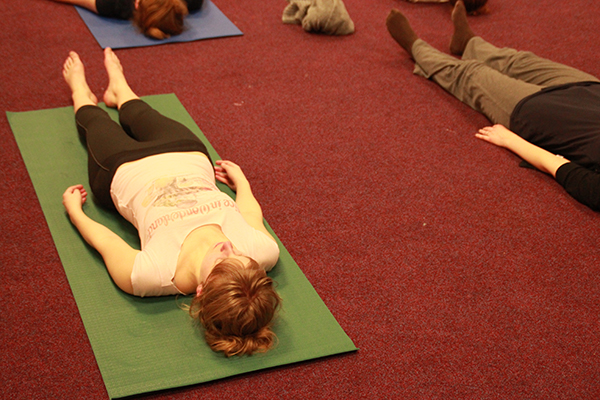
Yoga Nidra 2014

When I was reading Drama at the National School of Performing Arts, I was going through a very special period of my life. First of all, I was living in Mexico City, one of the biggest cities in the world, I was living on my own for the first time and, as I was in Drama School, I was going through lots of it in my life. I felt sad most of the time, I missed home terribly (I am from Puebla) and to make things worse, I didn’t know how to cook because my mum is an exceptionally good traditional cook who never let me set a foot in the kitchen, so I was eating poorly most of the time. Self-pity was a great obstacle for me. 

As much as I love theatre, in my experience, Drama School was very tough. Not only did the teachers encourage competition and jealousy, but they also brought the worse out of every student. In spite of this, there was a Voice and Speech teacher, Ana María Muñoz, who had a more integral approach to theatre practices. She taught us breathing exercises based on a technique called Eutony and a practice that she called La Huella (The Footprint), which bears certain similarities to Yoga Nidra. Tensions, memories, feelings of joy, feelings of despondency were brought forward and intensified by this practice. At the beginning there was a release but I soon realised I did not know what to do with so many feelings coming up and I had no extra tools to cope with them.

Little did I know that a few years later I would start practicing Yoga Nidra with Swami Pragyamurti. Yoga Nidra is a deep relaxation derived from Nyasa, a very old tantric practice (I will talk more about the origins in another post). Through this practice I discovered a nobleness of the body that could not be matched to that of the mind. This may sound a bit strange but just as it is a well-known fact that the mind can influence the body, I truly felt that the body had a special wisdom and a power to heal and transform the patterns of the mind. I learnt that relaxation is a process not a miracle. This time I was living in London, another big city, and I was reading a Masters in Performance and Culture. The practice of deep relaxation helped me sleep better and let go of negative feelings that were stored deep inside.

Yoga Nidra should  ideally  be accompanied by postures and meditation. This combination ensures a safer approach to body-mind. I am convinced that if you practice Yoga Nidra you do have to practice with someone who knows the technique very well and who is there to support you in a professional way. Ideally, this teacher can provide other yogic tools to manage the mind. By releasing tensions of the body, Yoga Nidra releases tensions of the mind. Much is said about the interconnection between body and mind and for me, this is embodied in the practice of Yoga Nidra.

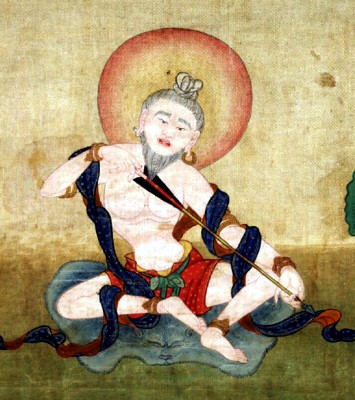
Saraha and his master

Saraha
Saraha

Sometimes we long for transformation, we would like a change of skin. Despite of this, we cling to what we know as reality, we cling to old habits, old patterns and beliefs. This is totally understandable, because we live in society, we have families, we belong to groups and where does this sense of belonging come from but our beliefs and ways of thinking? Only an act of rebellion will truly bring change. Do we dare to be ourselves? Will our loved ones accept this new person? There is a general deep admiration for rebellious people, but what would happen if we had a close encounter with a Buddha? Would we accept their way of thinking? Would we run away and think they were mad? Would we become followers or would we be able to integrate their sense of truth and freedom?

Something in the presence of Sri Kirti had attracted him; Sri Kirti was a great magnet. He (Saraha) dropped all his learning, he became unlearned again.

This is one of the greatest renunciations. It is easy to renounce wealth, it is easy to renounce a great kingdom, but to renounce knowledge is the most difficult thing in the world. In the first place how to renounce it? – It is inside you. You can escape from your kingdom, you can go to the Himalayas, you can distribute your wealth – how can you renounce your knowledge? And then it is too painful to become ignorant again, to become again innocent like a child.

Osho in The Tantra Experience 

Note: parenthesis is mine.